

From the Vault: Black Men Will Be the Difference This Election Cycle
An exclusive interview with Black Voters Matter co-founder Cliff Albright.

(This interview originally appeared in part in The Emancipator. But in light of rising suspicions around the results of the 2024 Presidential Election, it’s the opportune time to revisit this unpublished conversation in full.)
Since its inception in 2016, Black Voters Matter has made it its mission to “increase power in marginalized, predominantly Black communities.” And with our very democracy at stake in the upcoming presidential election, the revered voting rights and community empowerment organization has been more active than ever in educating voters and empowering our communities to stand up and be heard at the polls on November 5.
In this exclusive interview, Black Voters Matter co-founder Cliff Albright discusses the crucial role Black men will play in this election while also providing some insight into their needs, concerns, and involvement—or supposed lack thereof.
Jay Connor: Black voters have a lengthy history of being the Democratic Party's most loyal constituency. However, with each passing day, it feels like Trump is garnering more support from Black men than ever before. Is this merely internet conjecture? Or a troubling turn of the tide?
Cliff Albright: It’s mainly internet conjecture. [Laughs] We're not seeing any turning of the tide or any growing support among Black folks for Trump. At the end of the day, Kamala Harris is still gonna get about 90 percent of the Black vote.
Each election cycle, there are questions about Black voters and Black men. Two years ago, they swore [Republican U.S. Senate candidate] Herschell Walker was gonna get 50 percent of Black men because surely we only vote based on if somebody played football and won the Heisman Trophy, right? As if there are no other factors to determine how we vote. And as we all know, that didn't turn out so well for Herschell. At all.
So yeah, every election cycle, Black men do what we do: We vote for our issues, we vote for our interests, and we vote overwhelmingly progressive. Last night at the barbershop, we didn’t get into who was voting which way, but based on the issues and the attitudes that were expressed, there were no Trump fans. That’s also been my experience throughout the year, traveling with Black Voters Matter, but especially over the past month.
Thanks for clearing that up. Recently, Kamala Harris unveiled her Opportunity Agenda for Black Men, which includes forgivable loans, the federal legalization of marijuana, mentorship programs, and other intriguing opportunities. Some have dismissed this agenda as “demeaning,” while others are excited about its potential impact on our community. What are your thoughts on this agenda and the mixed reception to it?
It addresses a lot of issues that we’ve discussed with community members, partners, and staff members, so I think it’s a good agenda. We asked, “What would you want to see if there was a Black male agenda?” And the reason we asked that question is because, to whatever extent, there's been some hesitancy around Black men.
What we often hear is, “I need to hear more about us. What are the policies for us?” Even though the policies that she’s talked about up to this point—housing affordability, ending price gouging on groceries—are things that would obviously impact Black men. But they still want to know about policies that are specifically crafted for us. So then she comes out with this agenda, and now you have some people saying, “Oh, she’s pandering.” Well, what are we doing here? Either you want an agenda or not. So, what are you really talking about? Are you just using an agenda, or lack thereof, as an excuse because you just don’t want to vote for her?
I’ve had conversations like that, where we’ll go back and forth discussing these issues, then ultimately, when they’re resistant to accepting accurate information, you just have to ask: Is it because she’s a woman?
Well, to that point, former President Barack Obama has been criticized for his blunt approach to addressing Black men's perceived lack of support for Harris during this election cycle. He’s accused us of misogyny and, in turn, of welcoming harm to our communities by not doing enough to deter Trump’s reelection. That said, has he done more harm than good in how he’s addressed Black male voters? Should he consider changing his approach?
He should consider changing his approach, and I think he has. My critique, and that of some other brothers, is that we agree with the substance of what he was saying, but it was the presentation—the tone and the focus.
We’re talking about a situation in which—by even the most conservative estimates—80 percent of Black men are gonna vote for her. So there's all this hair-pulling over the fact that, “Oh, my God. Does that mean the remaining 20 percent are gonna vote for Trump?” But 80 percent is still the largest block of any demographic aside from Black women. If my son brings home an 80 on his test, I’m cool. [Laughs] That's a pretty big number! So, let's start with that recognition. The vast majority of Black men are gonna do what we've always done: join Black women and support the progressive candidate, whether they’re Black, white, male, or female. That's just what we do.
When you start the discussion there, now you can get into the other 20 percent. Ten percent of those are gonna vote for Trump because they always do, whether it was Trump, Bush, Romney—
Herschel Walker.
Or Herschel Walker! [Laughs] He got his 10 percent too! And within that group, yes. There's definitely a lot of misogyny and all that.
So you’ve got 80 percent that are already there, the 10 percent that are in The Sunken Place, and this other 10 percent that are undecided. And that's where these discussions have to take place. That's the 10 percent that when they say, “I need to hear more about our issues,” that’s perfectly fine. They're not just hiding patriarchy.
So when you go to them and say, “Look at this agenda. Look at healthcare and mental health, marijuana legalization, and small business development,” they say, “Okay, I hear you.” When you bring them Kamala’s record as a progressive DA, and you explain that it's simply not true that she was locking up thousands of Black men, they say, “Oh, man. I didn't know that.”
If I were Obama, the way I would’ve entered that conversation—which was at a field office with a bunch of Black men working on her campaign—would’ve been, “Look. Y’all are out here ten toes down for Kamala, and I know there are millions of Black men out there just like you. So, let’s clap it up for us. But we know that there’s some misogyny out there.” When you have a conversation that way, with that type of tone and acknowledgment, now, brothers hear you differently. We're tired of people looking at us like there's something pathologically wrong with us, because when it comes to voting progressive, white men don't keep up with white women. Latino men don't keep up with Latina women. Men are more conservative by about five to eight points within every group. That’s across the board—and Black men are no different.
Between the Biden administration's handling of Gaza, disenchantment with the Democratic Party, and other factors, there's a growing contingent of Black folks who are refusing to vote in this election. How would you address these specific issues and convince them to vote?
First, it depends on the issue. For some, it’s because of Gaza. For others, it’s immigration or something else that draws them to a third-party candidate. But fundamentally, we say, “Look. Whenever our rights are under attack, we don’t sit out. We fight back.”
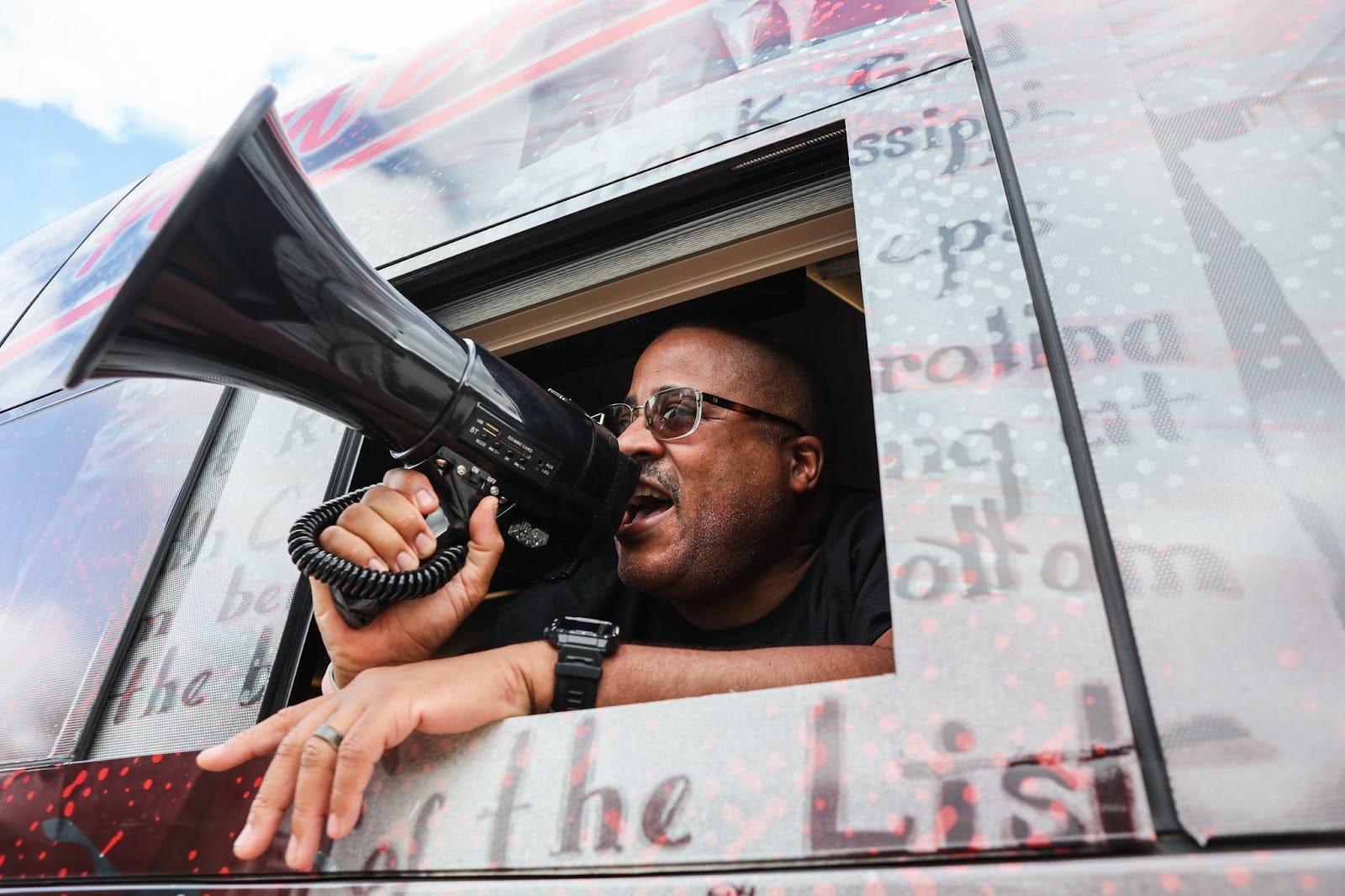
That’s why we named our bus tour—the bus I’m sitting on right now and our tour this entire year—We Fight Back. It’s to speak to that feeling of, “Oh, we’re gonna sit this one out. Nobody cares. We’re just gonna let them do Project 2025 and act like we don’t have anything at stake.” We say, “Nah, that’s not the way we’ve done it historically, and that’s not what we can afford to do at this particular moment.”
As Black men, we’re watching attacks on everybody. In terms of Trump, it doesn’t end with stop and frisk or absolute immunity for cops. There are threats to our sisters and mothers: our aunties and daughters—the women in our community. We’ve got Black women dying from just trying to give birth. Like Michelle Obama said the other day: “Are we gonna look at the women in our lives, the women we love, and say we stood by while this attack was taking place?” I know I’m not gonna do that. Most brothers aren’t gonna do that.
So, even those who are dissatisfied with any of the issues you mentioned, I think, ultimately, most of us will vote for the person who most directly addresses our concerns—or at least gives us the space to protest for them. If you’re unhappy about Gaza, you gotta pick the person who will let you do that. And right now, only one of these candidates allows for that.
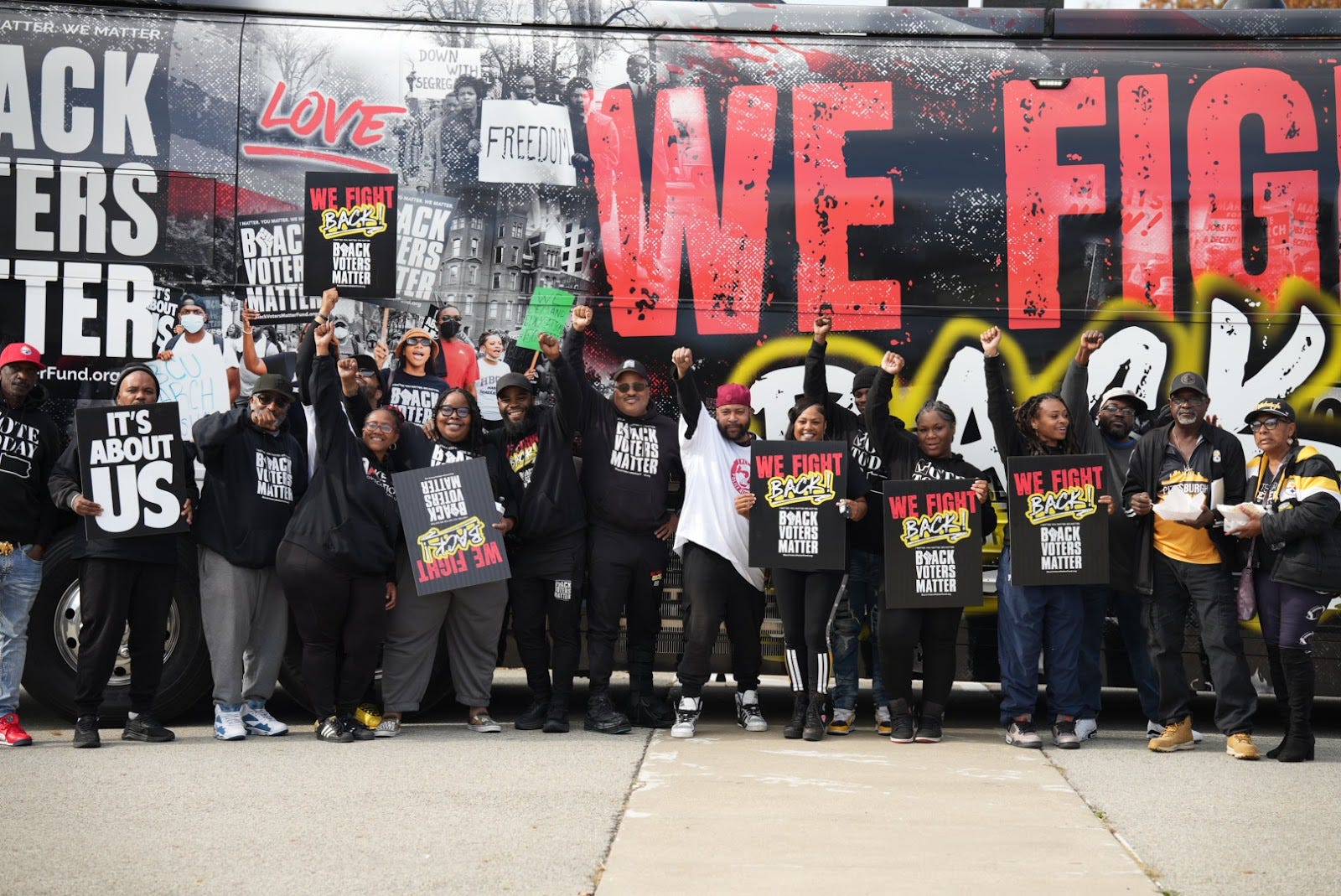
Black Voters Matter has been on the frontlines pounding the pavement during this election cycle with Get Out the Vote bus tours, social media campaigns, and other means to educate and empower our community. What has this experience been like during this election, and how are you specifically engaging Black male voters?
It’s been a little more frustrating than recent election cycles because the financial support hasn't been the same. It’s definitely not the same as it was in 2020, and honestly, not even the same as it was in 2022. So that's been frustrating. There’s a sense among some people that the threats aren't as serious as they were in 2020, which doesn't make sense because the threats are even more serious now.
It’s not like Trump was using dog whistles before; he’s always used a bullhorn. But now that bullhorn has gotten much more explicit. He’s doing Nazi rallies now. [Laughs] He’s openly flirting with Hitler. He’s talked about being a dictator on Day One, using the military on “his enemies within.” The gloves are off.
Yeah, he’s threatened to shut down the Department of Education and defund schools that teach the truth about American history: that it was built on the backs of our enslaved ancestors on stolen land.
It’s the same thing with the Environmental Protection Agency. We were in Pensacola, Fla., yesterday. There’s a landfill causing sickness in the immediate area. Getting rid of EPA, or any accountability regarding environmental justice, directly impacts Black lives.
So, what it feels like during this election cycle is a mixture of excitement and cautious optimism. This is a historic election that Black men are eager to be a part of. But there’s also nervousness and anxiety because this is America, and we know white folks. [Laughs] But I tell people, “We can’t sit in that anxiety. We have to be a part of the process.” That’s why we say everybody we touch is an organizer, whether it’s speaking at a rally, texting friends to attend one, cooking meals for the community, or doing some phone banking. We all have a role we can play to put that anxiety and uneasiness into action.
What do Black men want from our next president, and why, specifically, should we vote for Kamala Harris in this election?
Black men want to be heard. We want the same things that everybody else wants: We want good jobs and a nice house. We want our families to be safe and healthy. We want economic development. We want PPP loans like any other business. However, because of the unique challenges we face in this country, we also have additional, unique needs.
You’ve got those of us who are vocal about reparations. You’ve got those who are like, “We don’t want to be stopped and frisked or shot by police.” We also have unique health issues, which her agenda addresses. We all know brothers with diabetes, Sickle Cell Disease, prostate or colon cancer. I’ve dealt with two forms of cancer myself. These are concerns for us, and we want to hear that our elected officials not only recognize these concerns but have a plan in place to address them. That’s reasonable to demand.
I believe that Kamala Harris deserves our vote. Not just because she has a plan but because in her many roles as a public servant—whether as a DA, where she was doing job training for brothers facing the criminal justice system; as Vice President, with the work she’s done with economic development; or as a senator, with criminal justice reform by sponsoring the George Floyd Justice in Policing Act—there’s really nothing in there that’s brand new. She’s just trying to put herself in a better position to expand the work she’s already spent decades doing. That’s her track record.
At the end of the day, we’re gonna show up. After Election Day, it’s gonna be all over the news: “Black folks came out in record numbers.” So, don’t believe the narratives about who we are and what we’re gonna do. If we do our jobs, we’ll come out of this just fine. But on November 6 or January 20, that’s when the accountability begins. We have to hold not just Kamala but everyone on the ballot accountable. And I believe we’ll get there—because we fight back.