

Inside JUST KREATE, DJ Khalil's New Producer Playground—and Why He Isn't Afraid of AI
After three decades in the game, the five-time Grammy Award-winning producer has recruited The Alchemist and others to build the future of sound.

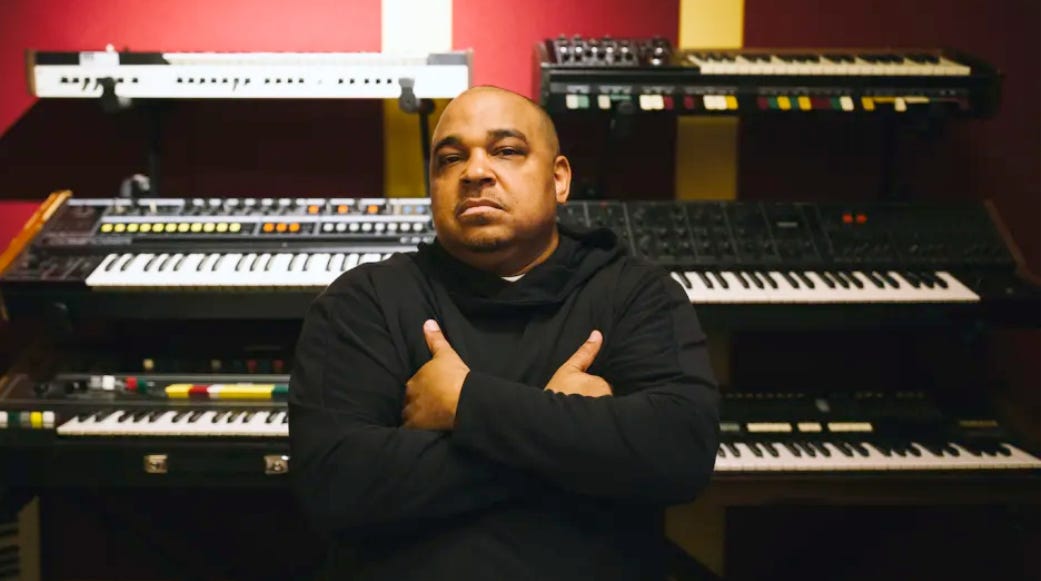
“I’m tired.”
After a career that’s spanned three decades—contributing to countless albums, signing on with Dr. Dre’s Aftermath Entertainment as an in-house producer, and collecting five Grammy Awards along the way—DJ Khalil has earned the right to collapse into the brown recliner backstage.
The Gibson Showroom in Los Angeles is uncharacteristically quiet, but within hours, it will transform into the Seattle native’s latest creation: JUST KREATE, an invite-only, one-night-only, live experience featuring five handpicked musicians that will be chopped up and flipped into a limited-edition 40-piece sample pack.
Because apparently, when you’re not preoccupied with gathering platinum plaques and Top 40 singles like Infinity Stones, this is how you kick off Black Music Month: by giving back to the producer community.
So exhaustion be damned, the other half of Self Scientific had plenty to discuss about his longstanding relationship with KRK Systems, the science behind sample packs, and his feelings about AI infiltrating the music industry.
This interview has been edited and condensed for clarity.
Jay Connor: You’ve been in the game for decades, working with everybody from Celine Dion to Jon Batiste to Dr. Dre. So as a five-time Grammy Award-winning producer and sonic architect, what role has KRK played in that journey?
DJ Khalil: Man, I’ve had a relationship with Dustin at KRK for a while. We’re like brothers—literally. We’re always thinking of cool ways to collaborate, and over the years, he’s supported everything I’ve done. At every turn, we’re trying to find really cool ways to support the creative community.
So it’s safe to assume you use KRK products pretty often?
I’ve always had different setups. I have my regular setup, but I also have other setups. I try different speakers all the time. During the pandemic, all I used were KRK.
Oh, word?
Yeah, I created a lot of dope stuff on that.
Shit, we heard. [Laughs]
[Laughs] I appreciate that. It’s funny because I have the eights. I don’t know if they’re the Rokits, but I love their monitors, man. I believe in them. I love what they do.
For sure. Now, how did this JUST KREATE collaboration specifically come about?
Dustin and I have been talking about it for a while. I want to do a series that’s kind of like Tiny Desk, but that involves musicians in different configurations. And I’m gonna have different producers curate it, so this is the first testing ground for it.
Oh, that’s hard.
Yeah, I’ve already talked to The Alchemist about it. I’m gonna have them curate what they want the band to play. It could be Argentinian progressive rock or whatever. And I’m gonna make those sounds and configure it to what they want to do.
Damn, that’s crazy. Yeah, I hit Focus… earlier and he said he’s coming through. So you might need to add him to that lineup too.
Of course! These are all my boys, so I’m gonna have them all do it. But this is just the beginning. I’m figuring out how to pull it off.
And I’ll be pulling up for every single one of them.
Word! [Laughs]
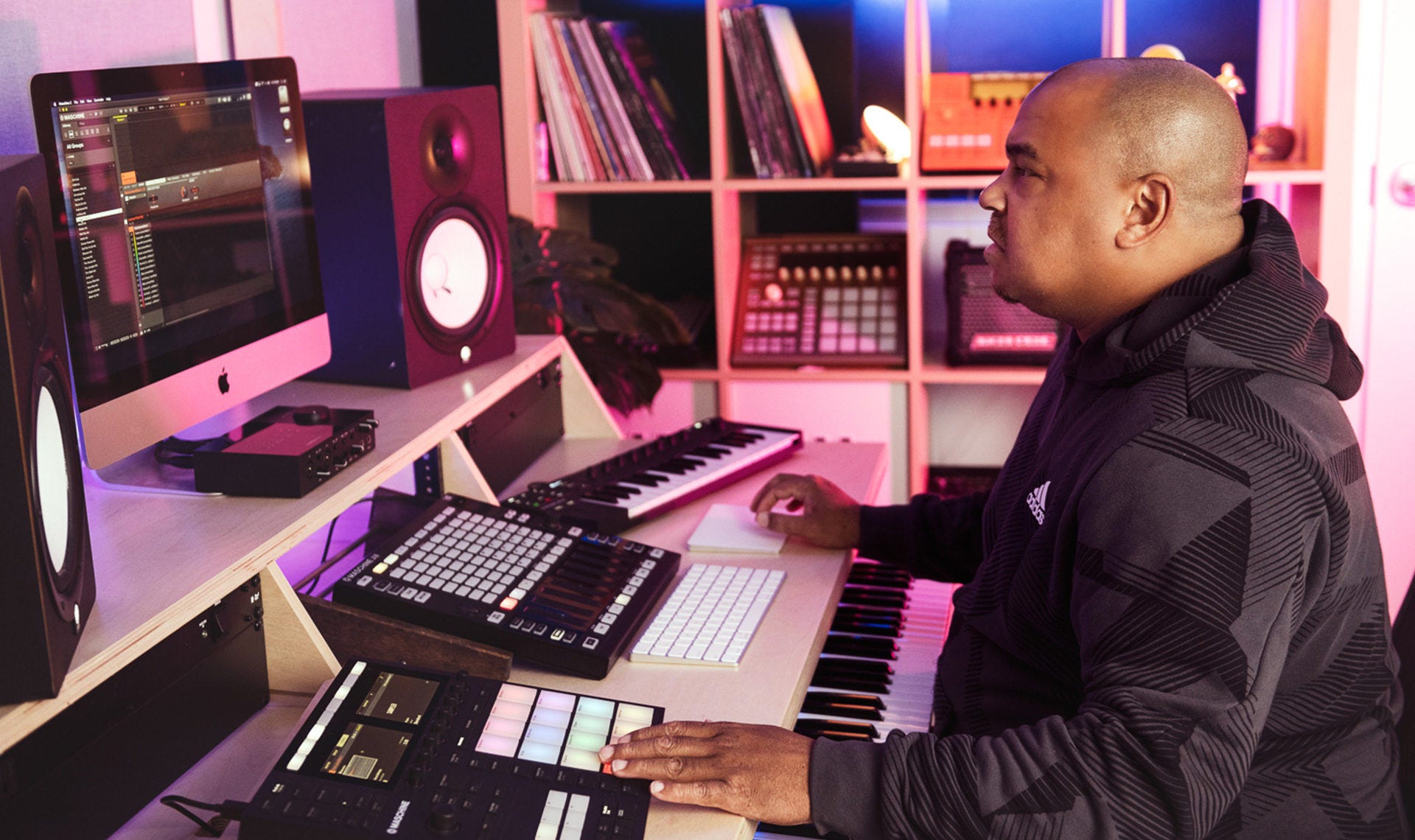
You’ve been the sauce behind so many big names and big songs, with 50 Cent’s “I Still Kill” being one of my favorites. How do you approach creating a song versus creating a sample pack?
A sample pack is different because the purpose of it is to give to other producers to use, you know what I mean? When I’m working on a song with an artist like 50, you’re cutting a record from their perspective—with their lyrics, and all that stuff. So the approach is different.
When I’m doing sample packs, it’s really just whatever flows. I might do the whole thing; I might bring in musicians. It’s way more experimental. It doesn’t always have a format. But when I’m working on a song, it’s got to have a format. It’s got to have chords.
When you’re constructing a sample pack, you’re probably also thinking, “What will they want to use?” Because as a producer, sometimes you want the quirks and the little things to add in or chop up.
Yup. That’s true.
You might even accidentally create something and be like, “Oh, shit. We gotta keep that in there.”
Exactly. Having mistakes in there and all that, you have a little more leeway with sample packs. Whereas with a song, it’s supposed to live forever.
So you have to perfect whatever serves that record. That’s the difference.
I got you. For those who are unfamiliar, how would you describe what a sample pack is?
A sample pack is just—in terms of what I’ve done—it’s a bunch of compositions, and you give producers access to the stems. So if you have a song, you can literally break it apart. You have the drums isolated, the lead synth and the chords, the rhodes, the guitar—all that stuff is separated. You can take those different elements and create something new with them. So it’s really just giving people the tools to create. It’s going beyond record digging because back in the day, you were stuck with whatever was on the record. Now, you have software that can make stems. So this is just another way to inspire producers.
Yeah, when it comes to sample packs, it’s interesting seeing so many big names churning them out now—like Don Cannon with Cannon’s Revenge or Jake One’s Snare Jordan series. I know Illmind has been doing those for a minute too. He was one of the first to jump on that, right?
Really, I was one of the first.
Talk your shit! [Laughs]
I’m just saying. [Laughs] Nobody was doing that. And they’ll tell you. I wasn’t necessarily making sample packs to give to people, but in terms of creating samples and giving them to other producers, I was definitely one of the first. For sure.
Respect due.
Now, other people have turned it into a business. I never looked at it that way. I just wanted another way to collaborate with other producers. But selling sample packs is dope. It’s created its own ecosystem.
What made you decide to pivot from creating music for artists to creating sample packs for other producers?
When good kid, m.A.A.d city came out, that introduced a whole new crop of producers. The sound changed, and I felt like my generation of producers wasn’t left behind, but there was a new crop that popped up. There was a new sound, and what those new artists were into is not what we typically did. So the best way to collaborate with them was to give them the music. They knew how to make the drums and all that, but they were still sampling actual records and getting killed on the publishing. So doing this was a way to collaborate with newer artists and producers. I felt like it really paid off.
At the time, you had Mike and Keys, THC, DJ Dahi—that was the shift, right? It was a whole new crop of producers that were ill. You know what I mean? I just remember being in the studio with Dahi, and he was playing stuff that was just—
“What the fuck.”
Dog! I couldn’t have even imagined that production could go there! So I had to adapt. What I like to do—boom bap—was not popular.
And that was your life’s work.
Yeah, I had to look at things differently, but they still needed dope music.
So it’s worked for me.
I remember when De La Soul dropped And the Anonymous Nobody... How they brought in a bunch of musicians, knocked out over 200 hours of jam sessions, then sampled from everything they recorded. Is that essentially what we can expect with JUST KREATE?
Yeah, this is just a short demonstration of what we typically do. I do jam sessions every Tuesday at my crib. We open it up to musicians, cram into a room, and just come up with stuff. And if it gets placed, then everybody eats.
So what I’m doing with JUST KREATE is bringing it out for people to enjoy, because what these musicians offer is just incredible. This is more of an abridged version of those sessions. Those are usually like 3 hours. This is only like 30 minutes.
Aiight, I got you. With so many producers using sample packs and other tools, how do you feel about producers starting to incorporate AI into music creation?
I think it’s dope.
Really?
You still have to be dope, no matter what. You still have to have taste. As a producer, you’re a tastemaker. If you have an ear, and you know how to use AI, I don’t see anything wrong with it. I use it. I’ve made some dope stuff with it; I’ve made dope stuff without it.
I think it also depends on the intent behind it. There’s a difference between using it as a tool and using it solely as a means to create. As creatives, we inherently feel compelled to create. I can’t see you sitting in front of a laptop and just being like… [Pretending to type] “Okay, I got a song!” You know what I’m saying? People like us have to be intricately involved. “Okay, let me take this piece and—”
[Laughs] Yeah. There are people who rely solely on AI. You’re starting to hear it now with Suno. You can hear it. As soon as the song comes on, you’re like, “That’s Suno.”
How can you tell it’s Suno? What is it you hear that’s different?
You can just tell. [Laughs] As a person that listens to a lot of music, I can hear it.
After three decades in the game, your ear is trained, bruh. [Laughs]
[Laughs] Yeah, and it’s gonna wear out—just like everything else. It’s industry standard at this point, but you’re gonna have to come up with something new.