

Just Dandy
The predominantly white 2025 Met Gala has an overtly Black theme rooted in resistance. What could go wrong?

(This essay originally appeared in part in The Emancipator.)
Be afraid. Be very afraid.
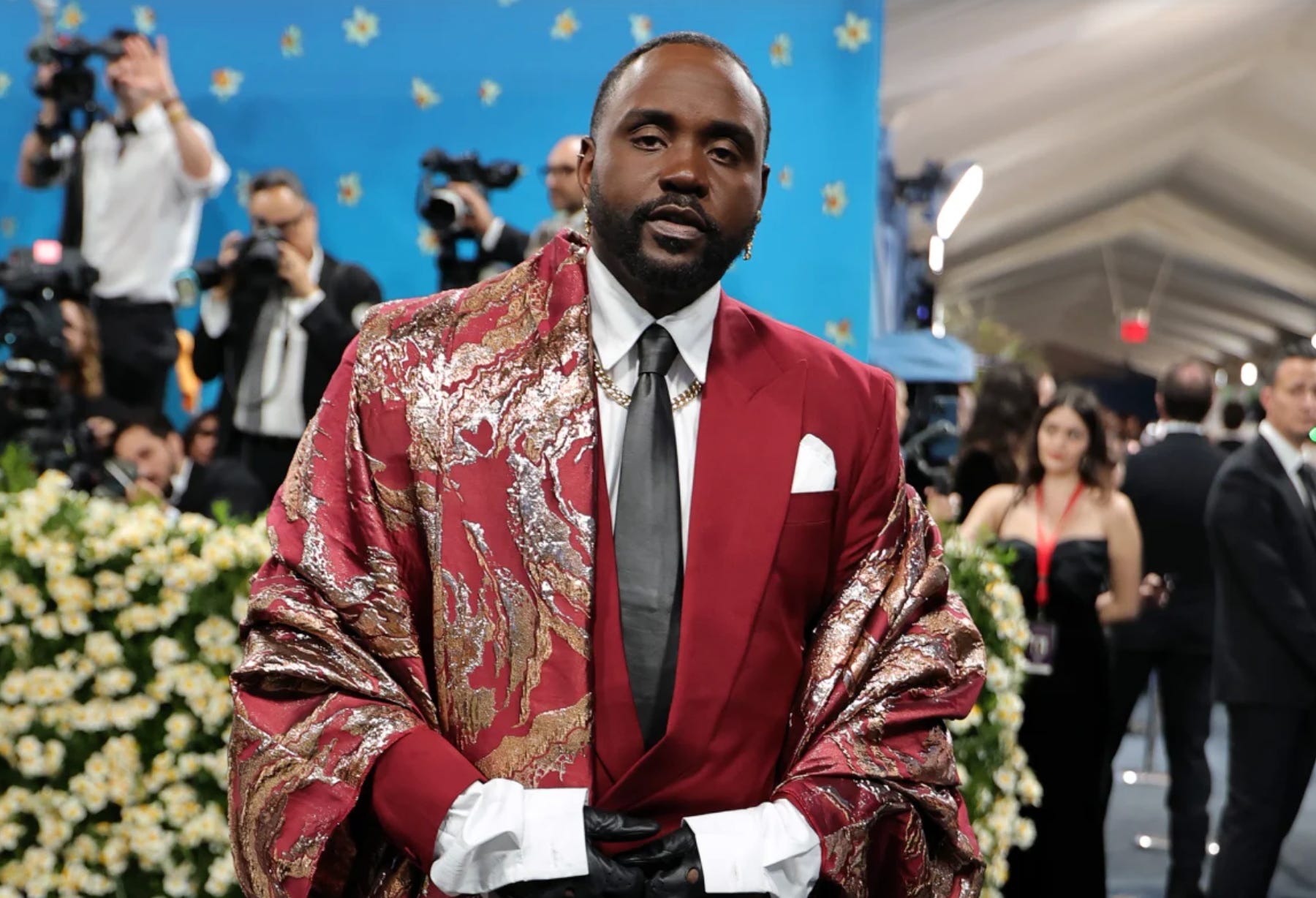
The Met Gala, world-renowned for its pomp and splendor, will make its annual descent upon The Metropolitan Museum of Art on Monday night. Stewarded by an unabashedly diverse, fashion-forward conglomerate of Black co-chairs—consisting of Pharrell Williams, Men's Creative Director for Louis Vuitton; Colman Domingo, activist and Academy Award-nominated actor; A$AP Rocky, Ray-Ban’s first ever Creative Director; and Formula 1 superstar Lewis Hamilton—this year’s soirée has positioned itself as an ode to Black Dandyism, courtesy of its official theme, masterminded by guest curator Monica Miller.
That theme is “Tailored for You,” in association with "Superfine: Tailoring Black Style"—the first Costume Institute exhibit to exclusively champion the indelible influence of Black designers, as well as the first to focus solely on menswear since 2003’s “Men in Skirts.”
And in remaining true to the Met Gala’s core tenets of pageantry and exclusivity, you won’t see my Black ass there, but you will see all six-foot-nine of LeBron James making his auspicious Met Gala debut amongst a throng of absurdly wealthy attendees, each desperate to become a trending topic on Twitter.
In a perfect world, this garish exploration of Black style, and more specifically, Black Dandyism, should be embraced with open arms. But as our life experiences remind us every day, our world is anything but perfect. And as Black folks—who’ve relied on fashion as a source of refuge for centuries, who’ve endured every manner of respectability politics imaginable, who’ve worn suit jackets and gowns as literal armor against the brutality of our oppressors—having the tools of our triumph being colonized and relegated to costumes is deeply concerning. Because not only does this invite disaster, but the very real possibilities of mockery, misunderstanding, and microaggressions.
To those who are unfamiliar with its concept, Miller defines Black Dandyism as a “matrix of identity” that, throughout its centuries of existence, utilizes “clothing, dress, and fashion” as a cultural “critique and creative mode.” Historically, it’s served dual roles as both a conduit for Black liberation and a mechanism for survival, spearheaded by the Raúl Grigeras and 18th-century Julius Soubises of yesteryear to brands like Black Menswear and the Dapper Dans of today. It’s as defiant as it is political, equal parts protest and performance in its innate ability to masterfully merge the debonair with dissent.
It’s just as much a Cab Calloway zoot suit as it is a pair of Billy Porter’s spandex leggings. It’s an audacious Janelle Monáe jookin’ down “tightropes” in The Palace of The Dogs. It’s Elizabeth Keckley asserting her dominion as a free Black woman in Abraham Lincoln’s White House. It’s Andre 3000 asking, “Can one rest in peace and violence?” during Outkast’s 2014 reunion set at Coachella.
But most importantly, it’s a manifestation of a uniquely Black experience. Black Dandyism doesn’t exist without the barbarous conditions responsible for its creation. Nor should it—especially in a predominantly white environment rife with individuals who routinely benefit from Black plight. And with the Met Gala making the curious decision to do exactly that, one can’t help but wonder how the revolution went from not being televised to being broadcast to millions under the leer of the white gaze.
Recently, many of us watched in confusion—and horror—as three-time Super Bowl champion Patrick Mahomes proudly announced his decision to rid himself of his luxurious locks of hair. Typically, an NFL star getting a haircut doesn’t warrant international headlines. But when it’s framed around questionable verbiage rooted in white acceptance, it’s gonna raise a few eyebrows.
“I told everybody during the season that win or lose, if we win three [Super Bowls] in a row or if we lose, I’m getting a haircut like, ‘That’s enough.’ I’m very excited,” Mahomes told news station KCTV5. “I can’t believe all you guys let me keep that nappy hair for so long. I look way better now with the short hair, so I’ll be keeping this going forward.”
Nappy?
Most Black folks would argue that despite having a Black father, that with his white mother coursing through his veins, the 29-year-old’s hair texture is about as “nappy” as a strand of spaghetti. But when you add that that same mother is a brazen Donald Trump supporter to the equation, you begin to wonder what the framework of Mahomes’ existence as a Black man has entailed. Was his “nappy” comment simply innocuous? Or a symptom of deeper factors at play involving the indoctrination of internalized anti-Blackness?
If these are questions commonly asked when white people are tasked with curating the lived experiences of our Black brothers and sisters, then are we not entirely justified in questioning the validity of predominantly white Met Gala attendees parading around as Black dandies? And does this sterilized “celebration” of Black style inherently desensitize the perils of respectability politics?
There are consequences to wearing culture as a costume, and while I’d love to believe the intentions of all parties involved are sound—specifically as it relates to the involvement of its Black co-chairs and guest curator Monica Miller—Black Dandyism is much more than merely attire. It’s an act of resistance that far too many Met Gala participants will be adorned in, but truly won’t understand—nor relate to.
I understand and had the same apprehensions when I heard the theme announced. There were inevitably going to be folks who got it wrong. I choose to look at it all as a celebration, I loved this theme and feel like it was expressly for those of us who do live the culture. I loved hearing the intention that was put into some of the looks.
As for Mr. Mahomes. I was sooo happy he finally cut that hair. He looks so much better this way. I had not however heard his "nappy" hair comments. Ughh so typical.