

'Spider-Man: Brand New Day' Helped Me Mourn the Man I Used to Be
What begins as another multiversal adventure becomes something far more unsettling: a meditation on grief, self-erasure, and the people we become in pursuit of our purpose.


As a lifelong Marvel Comics head, there are two characters I’ve always seen myself in: Deadpool, because despite having all the talent in the world, self-sabotage will always be his muse; and Spider-Man, because beneath the admiration and hero worship is a Nobel Prize candidate dodging eviction notices and barely holding his life together—with wisecracks, duct tape, and web fluid.
In short, he’s a hot fucking mess under that mask, and in ‘Spider-Man: Brand New Day,’ we peel back the spandex to reveal just how much of a hot fucking mess he truly is.
When last we left our friendly neighborhood Peter Parker, he was grieving the loss of Aunt May, ditching Tony Stark’s hi-techery for an OMNY card, and sacrificing his unbreakable bonds with his best friend and the love of his life to restore the multiverse. That means the world still loves them some Spider-Man, but nobody has any godly idea who that Peter person is now.
Thanks, Dr. Strange!
All of this would be psychologically catastrophic for just about anyone not named Donald Trump, but when you’ve already had Thanos snap you into five years of PTO, and you’re still mourning the death of that guy playing Doctor Doom, it’s safe to assume you’d come completely undone.
And Peter does exactly that.
Much like how former Celtics guard Isaiah Thomas stepped onto the court and dropped 33 points a day after losing his sister to a tragic car accident, or the way the rest of us would bury ourselves in spreadsheets while in the throes of a gruesome divorce, Peter goes full Spider-Man—as in: since the rest of the world believes Peter Parker doesn’t exist, Spider-Man is starting to believe it, too.
And by grieving himself, he commits the cruelest act imaginable: abandoning the one person who needs saving the most.
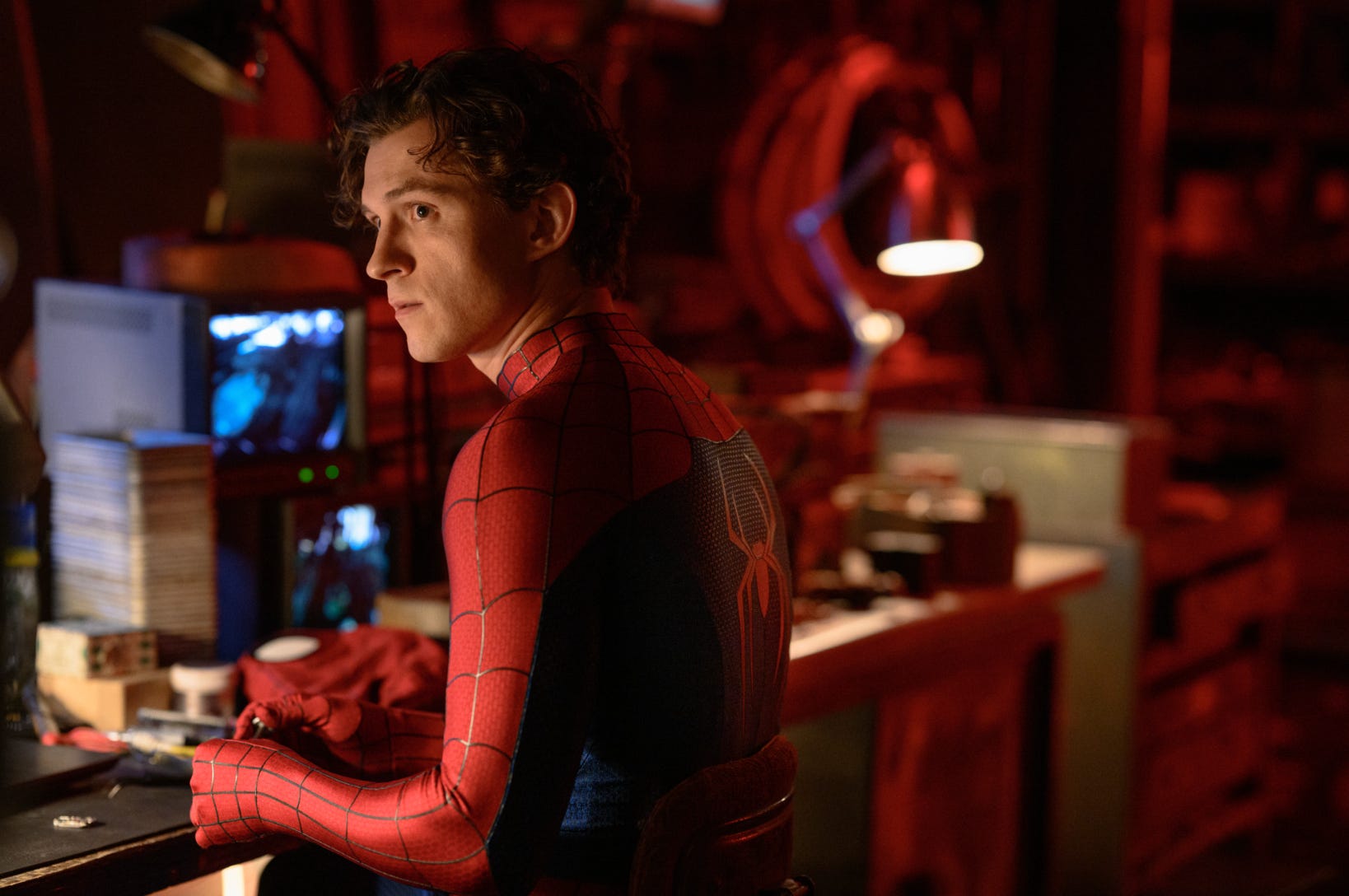
Without an alter ego—or pickleball tournament—to balance out all the bullet holes and bank robberies, Spider-Man spends what minuscule amount of free time he has…being Spider-Man.
Tweaking gadgets, scolding The Punisher, mutating into a heartbroken arachnid—you know, superhero stuff. And while our newly crowned Mayor Rivera appreciates his unyielding commitment to the cause, what she doesn’t appreciate is the compounding psychological and physical toll this endless cycle of sacrifice is taking on him—or her city.
Speaking of her city, those pesky X-Men seem hellbent on making their Marvel Cinematic Universe debut. So when Jean Grey starts Jean Greying, it opens a can of mutant-powered worms that only Spidey and Damage Control—the housekeepers of the Marvel Universe—are equipped to handle. However, this creates a dilemma that’s twofold: government agencies aren’t exactly forthright and honest, and a spiraling Spider-Man isn’t completely trustworthy himself.
Whoosah.
Now, let’s circle back to that whole “grieving himself” part. Because I’ve seen plenty of Marvel movies, and this is the first one to leave me sitting with my head in my hands for about 20 minutes afterward.
Completely triggered. As hell.
When I escaped Phoenix in 2014 to embark on an illustrious career in entertainment, I didn’t know how I was gonna make it happen, but I was 1,000% convinced I’d succeed. Fast forward 12 years, 7 months, and a couple of girlfriends later, and guess who blossomed into a critically acclaimed journalist and consultant? Go me!
But it came with a tremendous sacrifice: I became my career.
For a good decade strong, my entire life was consumed by what I thought was my calling. Being in the right rooms, having my work ethic praised by household names tripping over themselves to pretend to be my friend. It was miserable and tireless. I routinely skipped baby showers and birthdays, but made all the time in the world for movie premieres and award shows full of opportunists who couldn't give less than a shit about me as a person and only cared about leveraging their proximity to me for their own access or opportunities.
Welcome to Hollywood, ladies and gentlemen.
As a father, a big part of my ambition was driven by guilt: If I couldn’t hug my kid every day, I had no excuse not to be as successful as humanly possible. But after years of drowning in screenings, media appearances, pitch meetings, red carpets, and a life increasingly detached from reality, Jay evaporated somewhere along the way, and I transformed into Jay Connor—a public persona draped in tailored suits and external validation. For journalists, that can be extremely easy to do because people stop treating you less and less like a person and more and more like a means to an end.
When your job is to make sense of everyone else's lives, the life you lead is no longer your own.
As much as I love concerts, they stopped being fun because instead of enjoying the show like every other rabid fan, I spend them ducking out publicists, fine-tuning setlists, scouring for singers to hire, or thinking about story angles to assign for an interview. Netflix and chill becomes, “What if NPR asks me to hop on a segment about this? Should I take notes?” I can’t even listen to a new album without a compulsive urge to throw songs onto branded playlists—because yeah, that pays my bills too—or wonder if I should crack open my MacBook and knock out a review.
I’m constantly analyzing, absorbing, and dissecting the world around me for everyone else’s gain but my own.
Even this movie.

Since coming to my senses about a year ago—a good ugly cry in a five-star hotel during a work trip will do that for you—I’m still struggling to unravel the mess I’ve made of my own psyche. But if Spider-Man can rediscover Peter Parker, I hope the whimsical broke social worker is still somewhere buried inside me too.